Make your business applications queryable by AI
Artificial intelligence is discussed constantly in companies. But in most companies, the reality is more down to earth: useful data, customers, projects, stock, invoices and field work, lives inside a business application that is only accessible from a web browser on a fixed workstation.
That is a good start. But it is only part of the equation.
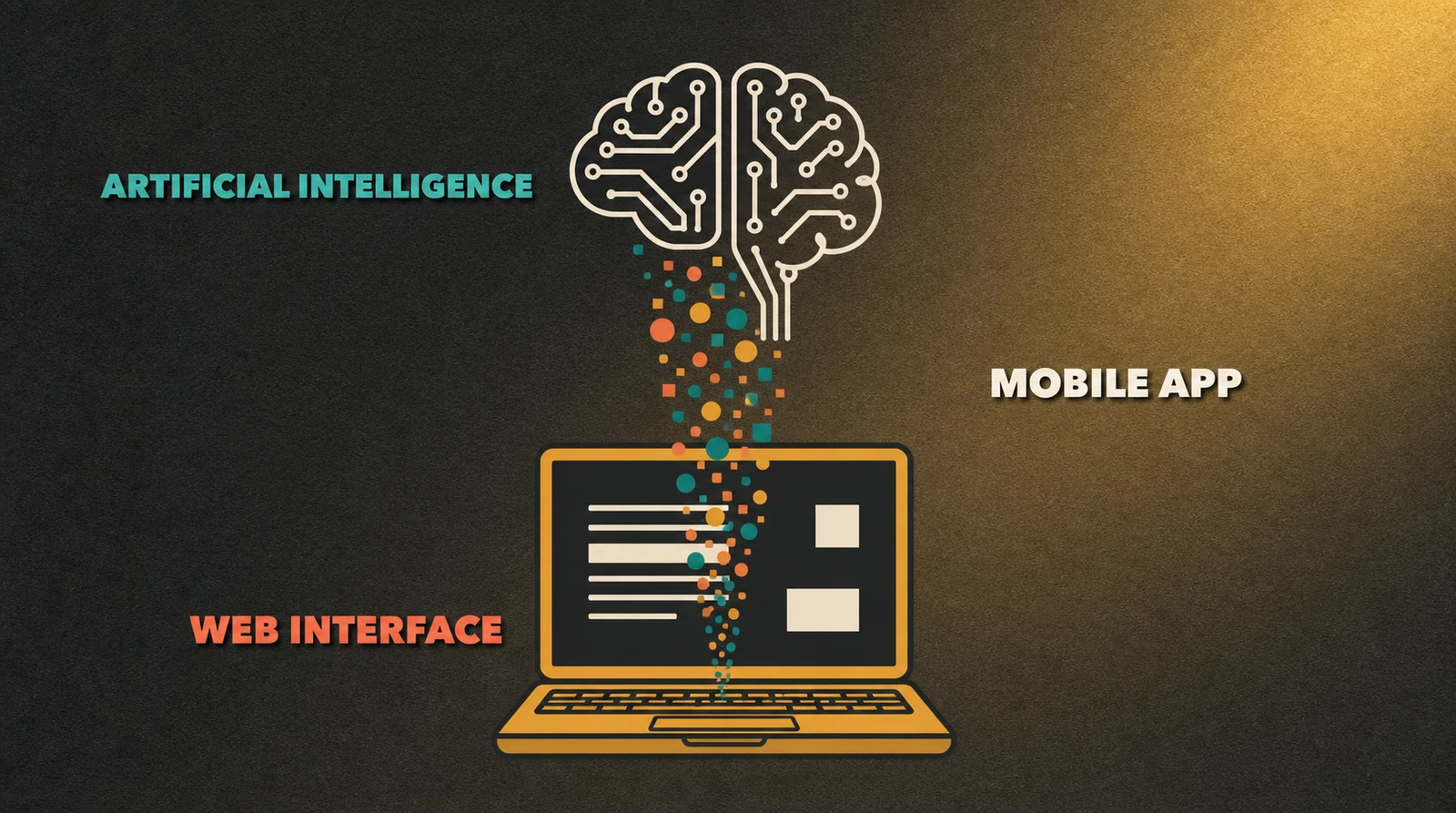
A truly effective business application today relies on three complementary layers: the web interface for daily work, the mobile app for the field, and an artificial intelligence layer for automation.
The web interface: the central workstation
This is the heart of the system. The web interface remains essential to:
- manage projects, contracts and invoices;
- track customer conversations and field work in real time;
- view dashboards and indicators;
- administer access rights and settings.
Whether it is a CRM, a job-site tracking tool, inventory management software or a team schedule, the principle is the same: the web interface is structured, complete and designed for office work. The goal is not to replace it. But it has limits: you need to be in front of a screen, connected, and know where to look for the information.
The mobile app: field access
This is the layer that is most often missing. Yet it is the one that changes daily work the most for teams that are not behind a desk.
A craftsperson on site, a salesperson in a meeting, a technician on an intervention, a manager on the move: all of them need access to their data where they are, not only where their computer happens to be.
A well-designed mobile app makes it possible to:
- receive push notifications: new customer request, urgent ticket, overdue invoice, scheduled intervention;
- validate quickly: accept a quote, sign a document, confirm a job-site milestone;
- check at a glance: project status, customer history, stock level, daily schedule;
- capture information in the field: document photo, observation, voice note, quick comment;
- stay responsive: answer a customer in 2 minutes instead of 2 hours.
It is not a “reduced version” of your software. It is the same database, the same access rights, the same business logic, but in a format suited to a pocket screen and mobile use.
The AI layer: intelligent automation
Now imagine adding a third layer: structured access to your application’s data, usable by an LLM, meaning a language model such as Claude or ChatGPT.
The principle is simple. Instead of navigating menus to find information, we create dedicated access points that AI can query. Not raw access to the whole database, but targeted, secure views that answer the most common business questions.
In practice, this can take the form of a command line tool or an MCP connector (Model Context Protocol), allowing a desktop AI assistant to query your business tool directly.
What it enables
Some examples depending on the type of application:
Customer management / CRM:
- “Summarize the Martin customer account: projects, payments, tickets”
- “Draft a follow-up email for each overdue invoice”
Job-site tracking:
- “Which job sites have fallen behind this week?”
- “List the interventions that have not been validated for more than 3 days”
Inventory management:
- “Which products are below the reorder threshold?”
- “Prepare a supplier order based on this month’s sales”
Scheduling / HR:
- “Who is available next week for an intervention in Rennes?”
- “Summarize this month’s overtime by team”
The three layers in action: a concrete scenario
Let us take a CRM as an example, although the principle applies to any business application.
Monday morning, 8:00. The AI automatically analyzes the application state and detects that an invoice for the Durand customer has been overdue for 7 days, that a support ticket has gone unanswered, and that the associated project has not moved forward for 10 days.
8:05. The manager receives a push notification on their phone: “Durand customer: 3 attention points detected”.
8:06. They open the mobile app, read the summary prepared by the AI, and approve in one tap the sending of a pre-written payment reminder email for the invoice.
8:10. Back at the office, the project manager opens the web interface to handle the ticket in depth, update the project schedule and document the exchange.
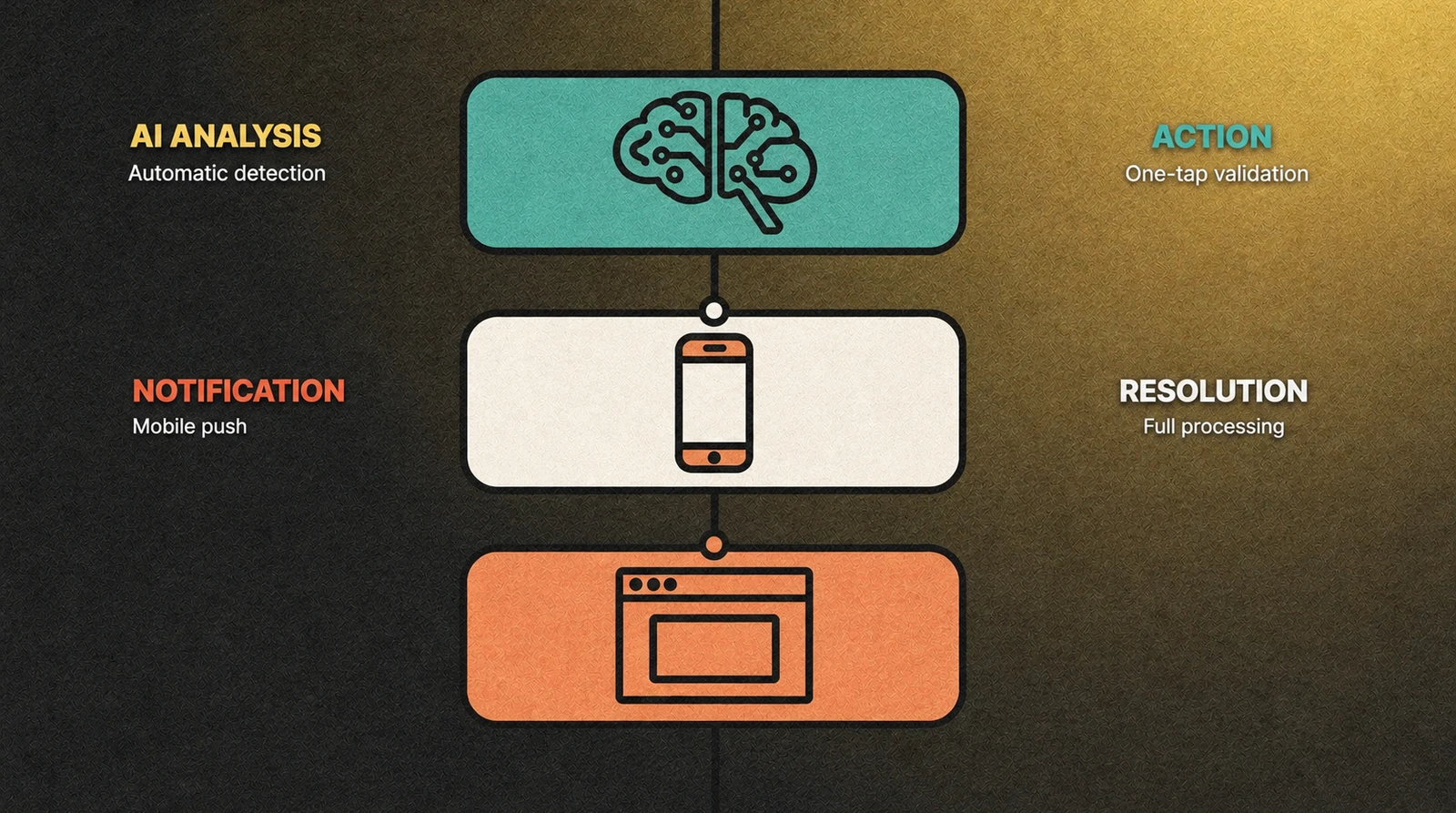
Result: in 10 minutes, three problems detected, one handled immediately, two being resolved. Without AI, those signals could have remained unnoticed for days.
That is what the three layers do together.
Tomorrow: autonomous agents
The three layers described above are already operational. But the natural evolution goes further: autonomous AI agents.
An agent is no longer an LLM waiting for a question. It is an assistant that acts by itself according to defined rules:
- it continuously monitors your business application;
- it detects situations that require action;
- it proposes or directly executes that action, with your validation.
For example: every morning, an agent can analyze overdue invoices, draft reminders, and submit them for approval through a mobile notification. Without being asked.
For the more ambitious: OpenClaw
Platforms such as OpenClaw already make it possible to connect AI agents to your business tools: management application, email, calendar, messaging. The agent becomes a real digital teammate: it reads your data, reasons over it, and can act across several channels, email, Telegram, web interface.
This is no longer science fiction. It is an accessible reality, provided you have a well-structured database and secure access, exactly what the previous three layers put in place.
Why this approach works
Whether you are independent, a craft business, an SME or a larger organization, when resources are limited, the same people often do everything.
That is precisely why this approach works so well:
- The web interface structures work and centralizes data
- The mobile app keeps people responsive without tying them to the office
- AI handles repetitive tasks and surfaces what really matters
All of this with a controlled cost: we do not rebuild what already exists, we enrich it. Each layer is added without replacing the previous one.
The right sequence to start
- A solid web application: the foundation. Well-structured data, clear access rights, complete interface.
- A mobile application: to extend access to the field and gain responsiveness.
- The AI layer: start with 3 to 5 high-value use cases, test on real data, then expand.
A partner, not a vendor
Building an application is one thing. Adopting it, evolving it and getting the most out of it is another.
That is why at AppExpress, we do not just deliver a product. We support our customers over time:
- Upfront consulting: identify real needs, avoid false good ideas, frame the project efficiently
- Custom development: web interface, mobile application, AI integration, each building block adapted to your business
- Deployment and training: support your teams as they adopt the new tools
- Continuous evolution: new features, adjustments, updates, technical support
The goal is simple: make your digital investment produce concrete results, not end up forgotten in a drawer.
Conclusion
A modern business application is no longer just a web interface. It is an ecosystem: web for steering, mobile for the field, AI for automation.
These three layers do not compete with each other. They complement each other. Their combination is what turns a simple management tool into a real competitive advantage.
At AppExpress, we design and support your business applications with three dimensions integrated from the start: web interface, native mobile application and artificial intelligence. From initial consulting to production follow-up, a single point of contact. Book a meeting to discuss it.